

Infantile nystagmus is a congenital condition that is estimated to affect between 1 in 1,000 and 1 in 6,000 children. It will typically be presented within the first few months after birth and is characterized by involuntary, bilateral conjugate oscillations of the eyes. This may be present at birth or may be present after up to 6 months of life. Individuals with infantile nystagmus are more likely to have high refractive error, with the majority having more than 2 D of astigmatism (Abadi and Bjerre, 2002).
Contact lenses are the preferred method of correction for these patients. Despite the constant motion of the patient’s eyes, they will always be looking through the optical center of their correction. Contact lenses may also be used to reduce the magnitude of the nystagmus. It is theorized that this is accomplished by providing sensory feedback to the cornea and lids (Self et al, 2020).
Case Description
A 13-year-old Hispanic male presented for a contact lens fitting following a low vision evaluation within our clinic. His medical history was largely unknown, but he had previously been diagnosed with infantile nystagmus. The patient was largely nonverbal and had an unknown motor deficit. It was recommended he be fit in contact lenses due to high levels of aniseikonia.
Entrance testing showed that the patient could count fingers at 5 feet though each eye individually and could see 20/150-sized LEA Symbols through matching. Keratometry suggested approximately 3.50 D of corneal astigmatism in each eye. This was matched by the suggested spectacle prescription given by the autorefractor of –8.00 –3.50 x 170 OD and –3.00 –4.00 x 174 OS. When trial-framed, he was able to see 20/200 LEA Symbols in each eye individually.
Soft toric lenses were initially selected to provide optical correction in the presence of significant aniseikonia. The patient was unable to perform application and removal himself, so his mother was trained on application and removal over 3 45-minute sessions. However, due to the patient’s strong blink reflex and narrow palpebral apertures, application and removal of these lenses proved to be prohibitively difficult.
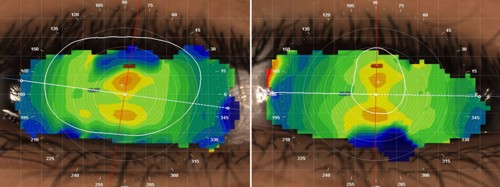
A bitoric lens was suggested (Bennett, 2024) due to the smaller diameter, easier manipulation of the lens, and high corneal astigmatism exhibited by the patient (Figure 1). The possibility of reducing the magnitude of the patient’s nystagmus was also discussed. Medmont scans were taken, and a bitoric lens (Art Optical) was ordered.
At the dispense appointment, the patient exhibited 20/100 vision in both eyes individually and together. The magnitude of his nystagmus had decreased by roughly 40%, and his eyes appeared to be more stable in primary gaze. Application and removal training was completed by the patient’s mother within 1 45-minute session. At subsequent follow-up appointments, it was reported that the patient seemed to be better engaged with his surroundings and participate in activities around the home. When questioned, the patient reported that he was comfortable with his new lenses and that he was happy with his vision.
Discussion
The successful management of this patient demonstrates how a GP lens, particularly a bitoric due to the high amounts of astigmatism present, can be a useful option in cases of nystagmus. While toric soft lenses may be considered, lens application and removal can be an issue in the presence of a strong blink reflex and/or narrow lid apertures.
Conclusion
The use of bitoric GP lenses should not be forgotten when considering options for our patients. They provide excellent vision by correcting the high amount of astigmatism. The smaller diameter aids in easier application and removal compared to soft lenses, especially in cases such as this where a caregiver is involved.
REFERENCES
1. Abadi, R. V., Bjerre, A. (2002). Motor and sensory characteristics of infantile nystagmus. The British journal of Ophthalmology, 86(10), 1152–1160.
2. Self, J.E., Dunn, M.J., Erichsen, J.T. et al. Management of nystagmus in children: a review of the literature and current practice in UK specialist services. Eye 34, 1515–1534 (2020).

To watch Dr. Millett discuss this case, click here.