


IN THE FUTURE, contact lenses may be very different than they are today. Rather than adding more elements to lenses (smart features, light blocking, drug delivery, etc.), it may be time to change the way patients use them. For decades, innovation has focused on what can be placed on the ocular surface during the day. Orthokeratology (ortho-k) challenges that assumption by shifting vision correction to a time when the patient is asleep.
Paradigm Shift
Ortho-k flips the traditional daytime model on its head. It allows freedom from daytime contact lenses and expands treatment options for patients who cannot tolerate traditional soft lenses due to factors like dry eye, discomfort, incompatability with activities like swimming, or exposure to dusty or windy environments. It also introduces flexibility for patients whose lifestyles make daytime wear inconsistent or impractical. Ortho-k is a treatment patients undergo, with advantages that extend well beyond the hours of contact lens wear.
Precision Era
Orthokeratology fitting is moving from trial-and-error toward prediction. Today’s chairside technology, from high-res topography to epithelial mapping, along with evolving insights into the biomechanical response of the cornea to hydraulic forces, is changing how lenses are designed. Subtle changes in treatment-zone size, lens alignment, and sagittal depth can now be evaluated with greater clarity than ever before. This allows ortho-k lens designs to become more individualized, and an increasing number of software-assisted designs have emerged to support this shift. The future of ortho-k will be defined by how precisely a lens design can be matched to the patient in front of us. In many cases, this is already happening in everyday practice.
Over time, ortho-k has changed from simple refractive correction into a clinical powerhouse in myopia management. Practitioners are no longer just correcting blur; they are influencing eye growth and long-term visual outcomes. This reframes contact lenses as a form of preventative care and highlights the importance of early intervention. As awareness of myopia progression continues to grow, ortho-k is positioned not just as an option, but as an early intervention strategy in managing a condition with lifelong implications.
Respecting Biology, Not Overriding It
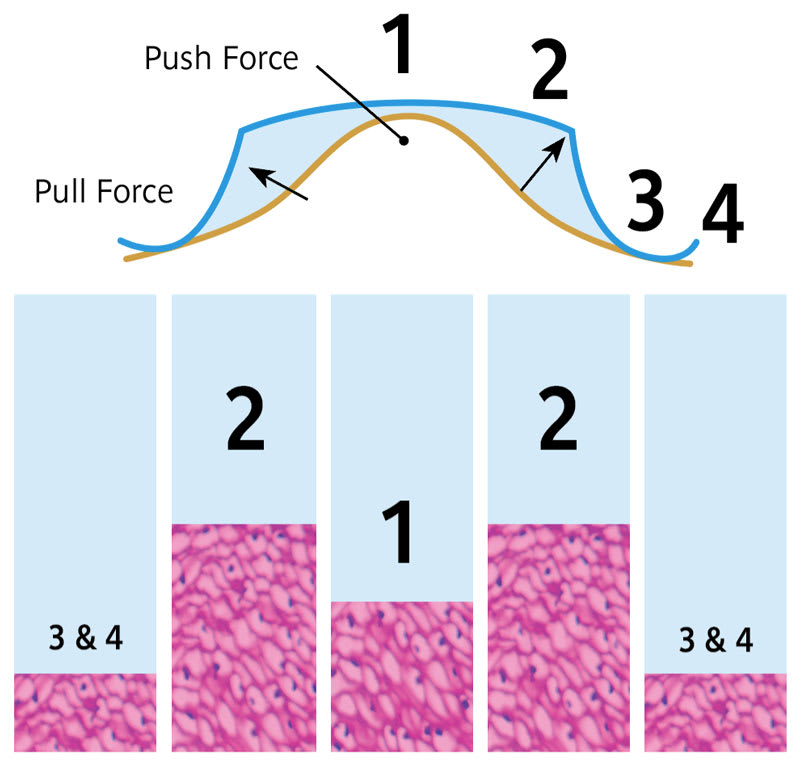
The cornea is made of living, responsive tissue (Figure 1). It adapts, but it also has limits. Understanding biomechanical boundaries is one aspect of advancing the field of ortho-k. Not every cornea responds the same way, and variability in epithelial thickness, rigidity, and contraindications must be considered. The future requires continued research into these differences, as well as clinical judgment in recognizing when to pause, redesign, or adjust treatment.
The Next Generation
As new optometrists graduate with training in ortho-k and fitting technology continues to expand, the next generation of contact lenses may not be defined by what we place on the eye, but rather by how precisely we reshape it. The concept of a “contact lens” may continue to evolve, becoming less about daytime wear and more about controlled overnight intervention. For many patients, the future of contact lenses is already here…it happens overnight.