


WHEN THINKING about the future of presbyopia management, consider pupil size, because it plays an important role in multifocal contact lens success. Currently, providers are generally focused on the patient’s refractive error and add power.
Many soft multifocal lens options utilize various center-near aspheric designs. Patients who have a large pupil diameter may have issues with their vision remaining clear at near when they look through the center-near zone and try to focus using the optics of the addition portion (Plainis et al, 2013). Center-near aspheric multifocals typically induce negative spherical aberrations, and center-distance designs tend to induce positive spherical aberrations (Jang and Lee, 2024).
Induced aberrations can impact patient visual quality, particularly contrast sensitivity. Higher-order aberrations (HOAs) have positive and negative values along with a magnitude. Some HOAs can be combined for greater impact on vision, while others can be canceled out to improve visual performance (Lopez-Gil et al, 2002) (Figure 1).
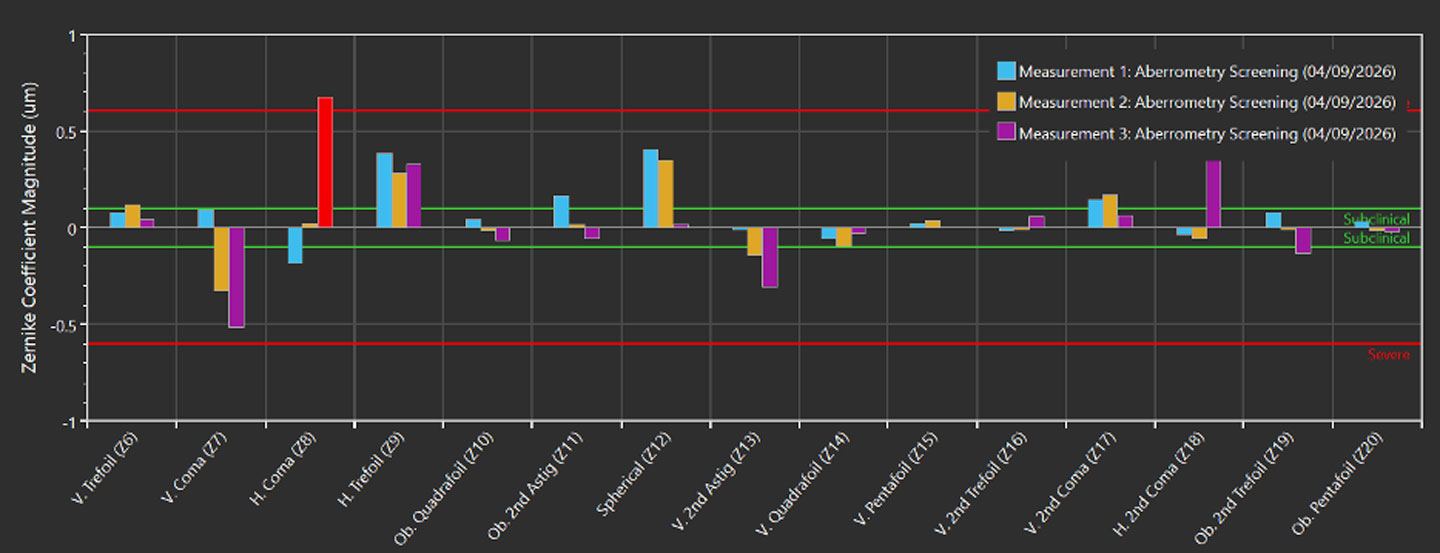
Coma, in particular, has been found to decrease distance visual quality but can also increase depth of focus at near (Applegate et al, 2003; Legras et al, 2012). This creates a tradeoff between distance and near vision that presbyopes wearing multifocal lenses often face.
Aberrometry can also help explain the impact of lens decentration: some studies have shown an increase in HOAs with decentered multifocal lenses (Fedtke et al, 2016).
As the pupil dilates, patients experience greater HOAs due to more defocused light entering the eye. Some interesting questions have arisen with the launch in the past year of 3 miotic pharmaceutical agents with presbyopia-related indications. These miotic drops function as cholinergic agonists acting on the iris sphincter to cause pupil constriction, thereby increasing the depth of focus.
However, they do carry some risks. Patients have reported side effects including headaches, redness, dimming vision, and ocular discomfort and irritation. The miotic effects of these eye drops vary and may last up to 8 hours.
With a greater depth of focus, the visual system can generate more range of clear vision over various distances. This pupil constriction would also decrease some of the eye’s inherent aberrations. It should be noted, however, that 1 study found a correlation between pupil dynamics and positive visual acuity (VA) performance and multifocal lens outcomes (Martínez-Plaza et al, 2025). This was seen in patients who had larger mesopic to photopic pupil size differences. This dynamic performance would be lost with the use of a miotic agent.
We need more research to determine whether there is a positive synergistic effect between miotic drops and multifocal lenses. HOA measurement could help answer why this combination may or may not be successful for some patients. There will still likely continue to be variability between individuals based on subjective visual tolerance as a function of inherent HOAs, pupil sizes, and lens positioning.
References
1. Plainis S, Atchison DA, Charman WN. Power profiles of multifocal contact lenses and their interpretation. Optom Vis Sci. 2013;90:1066-1077. doi: 10.1097/OPX.0000000000000030
2. Jang HS, Lee KJ. Spherical aberration changes in patients with early presbyopia wearing aspheric multifocal soft contact lenses in South Korea. Eye Contact Lens. 2024;50:475-481. doi: 10.1097/ICL.0000000000001120
3. Lopez-Gil N, Castejon-Mochon JF, Benito A, et al. Aberration generation by contact lenses with aspheric and asymmetric surfaces. J Refract Surg. 2002;18:603-609. doi: 10.3928/1081-597X-20020901-21
4. Applegate RA, Ballentine C, Gross H, Sarver EJ, Sarver CA. Visual acuity as a function of Zernike mode and level of root mean square error. Optom Vis Sci. 2003;80:97-105. doi: 10.1097/00006324-200302000-00005
5. Legras R, Benard Y, Lopez-Gil N. Effect of coma and spherical aberration on depth-of-focus measured using adaptive optics and computationally blurred images. J Cataract Refract Surg. 2012;38:458-469. doi: 10.1016/j.jcrs.2011.10.032
6. Fedtke C, Ehrmann K, Thomas V, Bakaraju RC. Association between multifocal soft contact lens decentration and visual performance. Clin Optom (Auckl). 2016;8:57-69. doi: 10.2147/OPTO.S108528
7. Martínez-Plaza E, Molina-Martín A, Mena-Guevara K, de Fez D, Gómez-Vicente V, Piñero DP. Impact of ocular aberrations and pupil diameter on vision with four daily multifocal contact lenses. Clin Exp Optom. 2026;109(4):764-773.