


CONTACT LENS DISCONTINUATION remains a persistent clinical challenge despite continued advances in lens materials, designs, and care systems. Reported discontinuation rates range from 12% to 27%, with contact lens discomfort consistently reported as the most common reason patients discontinue lens wear.1-4
But that discomfort is rarely caused by a single factor. Dry eye/ocular surface disease, inadequate visual performance, lens handling difficulties, financial considerations, and lifestyle changes may also contribute to dissatisfaction and eventual discontinuation.5

The Tear Film & Ocular Surface Society (TFOS) Contact Lens Discomfort Workshop emphasized that contact lens discomfort is multifactorial, arising from interactions between the patient and their ocular surface, the contact lens, the lens care system, and the environment.5
Patients do not always tell practitioners about the factors that are making contact lens wear less successful. Fortunately, many of these factors are identifiable and potentially modifiable. Clinicians can often identify and address the underlying reason for dissatisfaction by asking targeted questions, recognizing common clinical patterns, and implementing evidence-based interventions. This article reviews practical strategies to reduce contact lens dropout by addressing the 5 most common contributors: lens discomfort, dry eye/ocular surface disease, visual performance, lens handling, and financial or lifestyle factors.
Management of contact lens discomfort begins with identifying the underlying cause. Because discomfort is multifactorial, a careful case history provides valuable clues before the lens is ever examined on the eye.
When Does Discomfort Occur?
One of the most effective questions clinicians can ask is, “When does the lens become uncomfortable?” The timing of symptoms often narrows the differential diagnosis and guides management6-8 (Table 1).
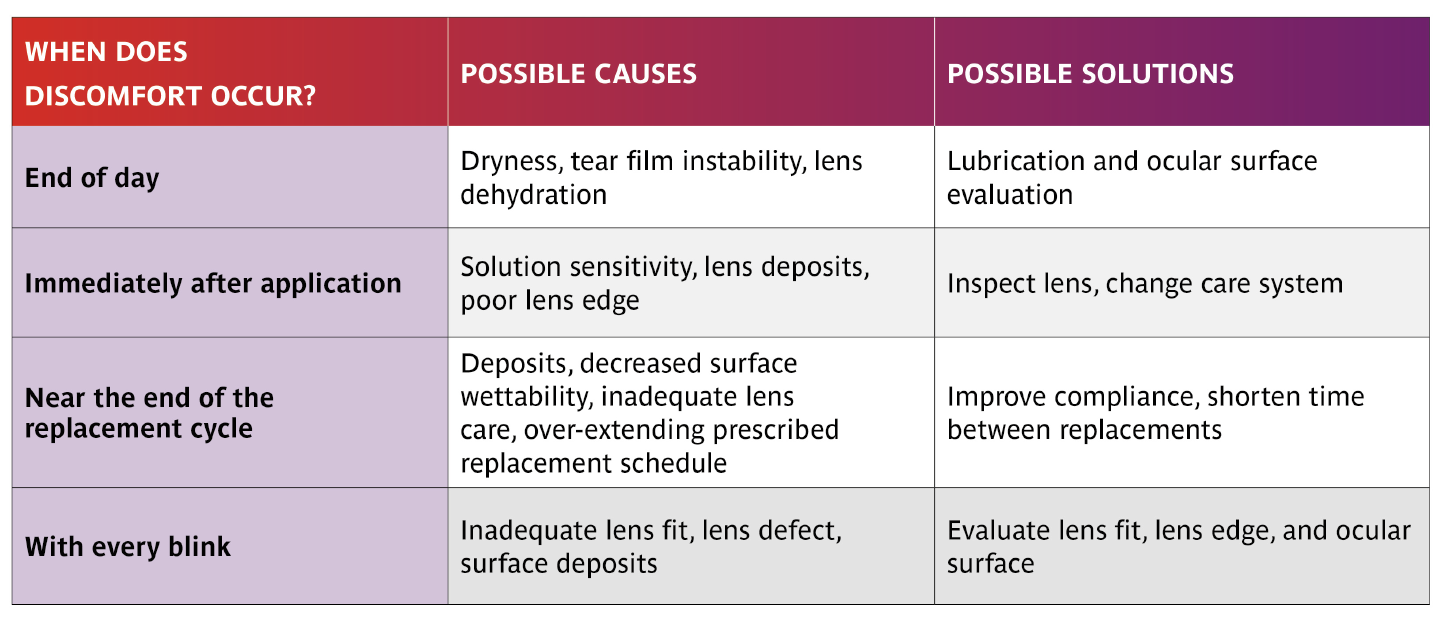
End-of-the Day Discomfort: Patients who report that their lenses become uncomfortable later in the day can benefit from strategies that improve ocular surface lubrication. Instilling a preservative-free artificial tear or contact lens rewetting drop during the day may extend comfortable wearing time. Rather than asking the patient to instill the lubrication when symptoms arise, a prescribed routine dosage can be added to the patient’s normal daily routine.
Some patients may need to temporarily remove their lenses during the day to allow the ocular surface to recover before reapplying. Others, particularly those wearing reusable lenses for extended workdays, may achieve better comfort by replacing the original pair with a freshly disinfected second pair later in the day. End-of-day discomfort should also prompt an evaluation of the ocular surface, as tear film instability and meibomian gland dysfunction (MGD) are common contributors to end-of-day symptoms.
Discomfort Immediately After Application: If the symptom is of recent onset, inspect the lens surface for deposits and the lens edge for tears. Consistent symptoms of discomfort immediately after lens application should prompt consideration of solution sensitivity, lens contamination, or a damaged lens. Depending on the findings, changing the lens care system or replacing the lens may improve comfort.
For 2-week or monthly replacement lenses, switching the patient from a multipurpose disinfecting lens solution to a hydrogen peroxide-based care system may reduce exposure to preservatives and residual solution incompatibility.5,9 For some patients wearing daily disposable lenses, rinsing the lens with preservative-free saline immediately before application may improve initial comfort.
Discomfort Near the End of the Replacement Cycle: Patients who experience discomfort consistently as they near the replacement date may be experiencing the effects of surface deposits. Review the patient’s lens care routine, paying particular attention to their compliance with mechanical rubbing and replacement schedule.
If the patient is compliant with lens care and replacement recommendations, more frequent replacement may improve comfort. When possible, prescribe daily disposable lenses to eliminate deposit accumulation and solution exposure.10 If daily disposables are unavailable for the patient’s prescription, replacing monthly lenses more often than recommended, for example every 3 weeks instead of 4, may improve comfort.
Discomfort With Every Blink: Discomfort that occurs with each blink should raise suspicion of upper lid–to–lens edge interaction,11,12 a mechanical irritation, or surface defects. Careful evaluation of lens centration, movement, coverage, and integrity may identify the underlying problem.
The onset of symptoms can guide the practitioner in identifying the underlying cause of discomfort. Mechanical causes tend to produce symptoms immediately after application or with each blink, whereas tear film instability and ocular surface disease more commonly produce symptoms later in the day.
Dry Eye and Ocular Surface Health
Patients who have an unstable or compromised ocular surface are more susceptible to contact lens discomfort and discontinuation. Before recommending a change in lens material or design, eyecare providers should evaluate and manage any underlying ocular surface conditions.5 Not every patient who reports dryness has dry eye disease, and not every patient who has dry eye disease reports dryness.
Fluorescein assessment of tear breakup time (TBUT), corneal and conjunctival staining patterns, and tear meniscus height, along with evaluation of the eyelid margins, meibomian gland function, and blink completeness, can help identify ocular surface abnormalities that may be contributing to contact lens discomfort. Fluorescein assessment of TBUT and ocular surface staining can provide valuable clues about why a patient is uncomfortable (Table 2). The location and pattern of staining may help distinguish tear film instability from mechanical or exposure-related stress and should be considered alongside symptoms and contact lens fit. When staining suggests an underlying ocular surface problem, address the ocular surface before assuming the contact lens itself is responsible.13-15
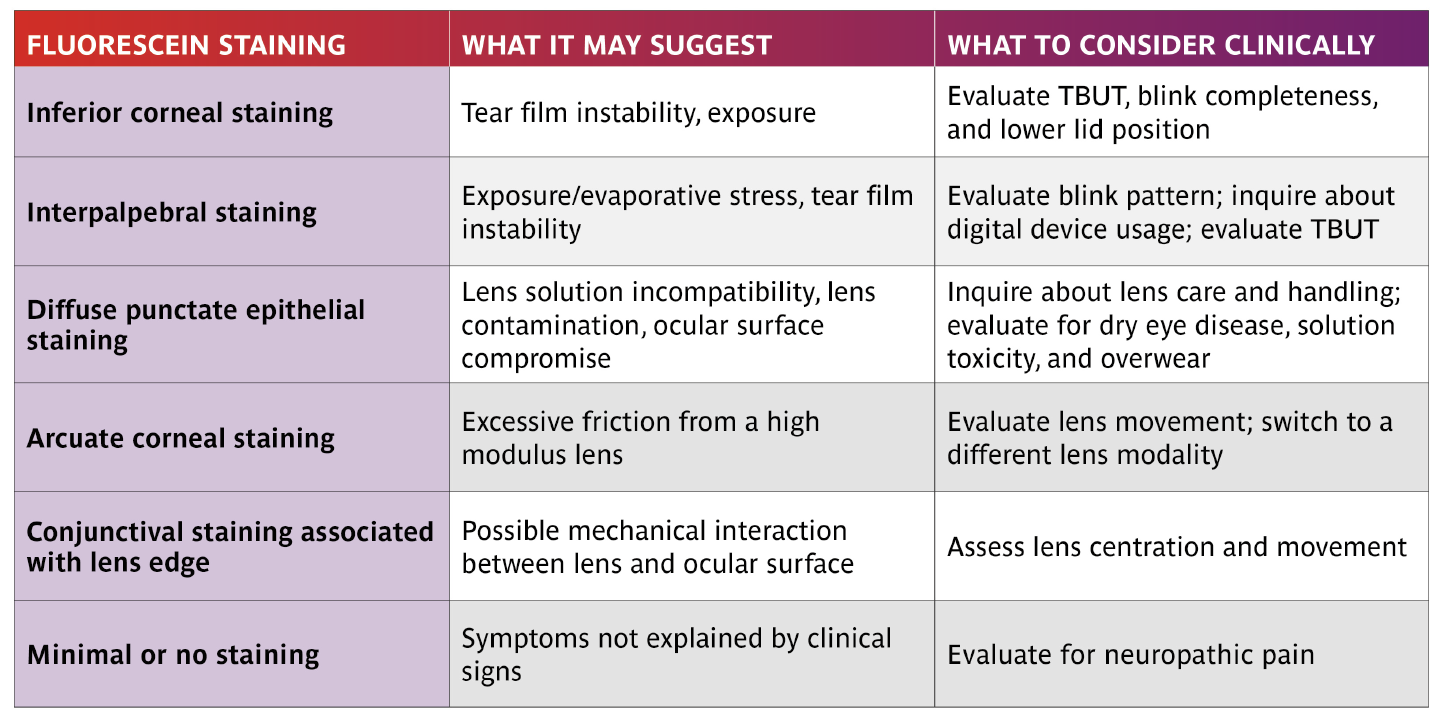
Optimize the Tear Film: Patients who have a short TBUT are wearing a contact lens on an already unstable tear film, which may further challenge tear film homeostasis and amplify symptoms of dryness and discomfort. Identifying the underlying cause of tear film instability, which could be evaporative dry eye, aqueous deficiency, inflammation, incomplete blinking, and/or environmental factors, can help guide treatment and improve the likelihood of successful lens wear.16
For patients who develop symptoms predictably during the day, recommend scheduled preservative-free artificial tears or contact lens rewetting drops before symptoms typically begin, rather than relying solely on symptom-driven use. Patients should also be reminded to blink fully and regularly during prolonged digital device use and to take periodic breaks from near work. Environmental factors such as fans, air conditioning, and low humidity should also be considered, particularly when symptoms are worse in a particular setting. For patients who have evaporative dry eye, treatment should be directed toward the underlying cause and may include therapies that improve the lipid layer and reduce tear evaporation.
Optimize the Eyelid Margins and Meibomian Gland Function: Patients may not recognize that their symptoms originate at the ocular surface and may instead attribute discomfort to the contact lens itself. Without identification and treatment of the underlying condition, these patients may simply discontinue lens wear rather than seek treatment for the ocular surface problem.
For patients who have MGD, evaluation of gland structure and function, including meibum quality and expression, can identify patients who may benefit from targeted treatment. For some patients, management may include consistent eyelid hygiene, warm compresses, lid massage, and other therapies directed toward improving meibomian gland function. Patients should be encouraged to establish an ocular surface maintenance routine, particularly during periods of contact lens wear.
The eyelid examination should also include evaluation of Demodex blepharitis. Collarettes at the bases of the lashes are a clinical sign of Demodex infestation and should prompt consideration of targeted treatment.17
Ocular Surface Disease: When ocular surface disease is significant, the solution may not be another soft lens. In patients who have significant ocular surface disease associated with systemic conditions such as Stevens-Johnson or Sjögren’s syndromes, scleral lenses may provide an alternative to soft lenses; they create a fluid reservoir between the posterior lens surface and the ocular surface. This reservoir can provide continuous hydration and protection while correcting vision.18,19 Many symptomatic patients present with a combination of aqueous and evaporative dry eye components, requiring a comprehensive approach to ocular surface management.
Visual Performance
Visual performance is another potentially modifiable factor in contact lens dropouts. Patients may discontinue lens wear when contact lenses do not provide the visual clarity, stability, or range of vision they expect. New contact lens wearers may be susceptible to contact lens discontinuation because they may attribute poor visual performance to unsuccessful contact lens wear when a simple prescription modification is all that is needed.1
Is the Refractive Error Adequately Corrected? Consider performing a spherocylindrical over-refraction to determine whether residual refractive error, particularly astigmatism, is contributing to reduced visual performance. Some patients may be wearing a spherical soft lens when a toric lens would provide better correction and could prevent dropout. For patients already in a toric lens, assess both lens rotation and stability. A small amount of lens rotation may be clinically acceptable, depending on the amount of astigmatism, so long as the lens is stable. Oblique cross-cylinder calculators can help determine the compensatory lens axis when adjusting for lens rotation.
Visual performance complaints may reflect reduced visual acuity, but may also present as intermittent blur, fluctuating vision, ghosting, halos, glare, or reduced contrast, particularly at night. If vision improves after a blink or changes throughout the day, tear film instability may be contributing to the visual complaint and should be evaluated before simply changing the prescription. For patients who experience reduced visual quality at night but otherwise remain successful contact lens wearers, an occasional overlay spectacle may be an option that allows them to continue wearing contact lenses.
Is the Problem Monocular or Binocular? Visual complaints are not always due to the contact lens power itself. Binocular vision dysfunction may also contribute to dissatisfaction and should be considered when symptoms persist despite an apparently adequate refractive correction.20,21 Patients may achieve good monocular visual acuity, yet experience asthenopia, headaches, eye strain, fatigue, difficulty performing prolonged near work, or intermittent binocular diplopia. A binocular vision evaluation may be warranted when these symptoms are present.21
Does the Patient Need an Add? As patients enter or progress through presbyopia, their visual demands may change. A contact lens prescription that still provides satisfactory distance vision may no longer meet the patient’s near or intermediate visual demands. Patients should be offered the option of multifocal, monovision, or modified monovision contact lenses. Ask the patient what they need to see. A patient who spends 8 hours on a computer has different visual demands than someone who primarily needs distance vision and occasional near vision.
What Are the Patient’s Expectations? Patients should understand that contact lenses may not reproduce the exact visual experience they have with spectacles. This is particularly important when fitting multifocal and monovision or fitting patients with a significant amount of astigmatism. Discussing expected visual performance before lens wear can help distinguish normal adaptation from a correctable problem and may prevent premature discontinuation. Good visual acuity may not mean visual satisfaction. A patient may achieve 20/20 acuity, yet report poor visual quality because of fluctuating vision, reduced contrast, glare, halos, or ghosting.
Lens Handling
Lens handling is another potentially modifiable contributor to contact lens discontinuation. Patients may become frustrated with contact lens wear if they struggle with application, removal, or lens care. Although these challenges are common among new wearers, handling difficulties may also develop later because of aging, reduced dexterity, changes in vision, or lifestyle demands. Rather than assuming these patients are poor contact lens candidates, clinicians should identify the specific obstacle and provide targeted solutions.
Problems With Application and Removal: Do not assume that patients are comfortable with lens application and removal. Ask them about their experience and, when possible, observe their techniques. In many cases, a 5-minute demonstration will reveal the underlying problem and lead to a practical solution that keeps the patient in contact lenses.
Some patients can easily apply the lens but may struggle with removal, or vice versa. If the patient is having difficulties with lens application, they may need some further training to feel more confident. Ask whether handling has recently changed. Perhaps the patient has developed a tremor or noticed their dexterity has changed. If they are a new wearer, they may benefit from learning multiple techniques. Some individuals benefit from looking up and applying a lens without the use of a mirror, while others find that good illumination and a mirror go a long way toward successful application and removal.1
Review Lens Care Routine: This is one area that can be overlooked by experienced wearers. Patients may develop noncompliant habits over time. Ask them to demonstrate how they care for their lenses. Rather than asking specific questions such as “Do you rub your lenses?” ask them to walk through their routine. Pay attention to behaviors such as topping off solutions, not adequately rubbing their lenses, poor lens case hygiene, use of expired solutions, or overwear of lenses. Sometimes the problem isn’t the physical comfort of the lens; it may be that a noncompliant behavior is causing deposits or discomfort. Sometimes patients find routine burdensome and, if so, they may no longer be candidates for rewearable lenses.
Could a Different Lens Modality Help? For patients who hate cleaning lenses, a daily disposable modality would be an ideal lens option. For patients having issues with lens application and removal, a different soft lens diameter or a different modulus may help.
Overall, some patients simply need a small amount of attention. An additional training visit could teach needed skills; a patient may be too embarrassed to ask or unaware that another training visit would improve their handling difficulties. For the eyecare practitioner, a small investment in chair time may prevent long-term contact lens dropouts. Patients often discontinue contact lenses quietly rather than returning to the clinic for help with handling problems.
Financial/Lifestyle
Financial and lifestyle factors may also contribute to contact lens discontinuation.3 Patients’ visual needs, work demands, daily routines, and financial priorities change over time. Rather than assuming patients no longer wish to wear contact lenses, clinicians should explore whether practical barriers are limiting successful wear.
Ask the patient to tell you about a typical day wearing contact lenses: “When do you wear your lenses? When do you remove them?” Is the patient wearing them only on the weekends, for hobbies or sports, or only for special occasions? Do they remove them immediately after work? Are they alternating contact lens wear with glasses? These questions can reveal opportunities to modify the wearing strategy rather than abandoning contact lenses altogether.
The Right Modality: The most appropriate modality may depend on how frequently the patient actually wears their lenses. If a patient wears their lenses twice a week, a daily disposable modality may be more convenient than a 2-week or monthly replacement modality. Daily disposables eliminate the need for cleaning and storage, reduce the need to remember a replacement schedule, and eliminate the need to purchase lens care solutions. For some patients, these conveniences may improve adherence and make contact lens wear easier to incorporate into their routine.
Cost Isn’t Always the Sticker Price: When cost is a concern, consider the total cost and burden of lens wear, rather than focusing solely on the price of the lenses. A daily disposable lens has a higher per-lens cost but eliminates the need for purchasing solution and lens storage cases and reduces the time required for lens care. For some patients, the convenience may justify the additional expense.
If cost remains a barrier, discuss the available options rather than assuming the patient must discontinue contact lens wear. Different lens modalities and replacement schedules offer different price points, and patients may be unaware of available rebates or insurance benefits. A conversation about cost can sometimes identify a more sustainable option without abandoning contact lens wear altogether.
Adapt to Lifestyle Changes: Changes in lifestyle do not necessarily mean that contact lens wear needs to end. A patient who previously wore lenses for work may naturally reduce wear after retirement. A new parent may find glasses more convenient during the early months with a baby. Someone who begins traveling more frequently may find daily disposable lenses useful while away from home.
Ask whether the patient’s current lens-wearing pattern still fits their lifestyle. Contact lens wear does not have to be an all-or-nothing decision; patients may benefit from having different options to meet their changing visual and lifestyle needs. For example, a patient might use daily disposables for travel or sports while continuing their usual 2-week or monthly lenses for everyday wear. The goal is not to convert every patient to a single modality, but to find a strategy that works for how they actually live.
Don’t Assume Full-Time Wear Is the Goal: Not every patient needs or desires full-time contact lens wear. For some individuals, successful occasional wear may better align with their lifestyle and may reduce the likelihood of discontinuation.
The key question may be simple: “What’s keeping you from wearing your contact lenses more often?” The answer may reveal a problem that can be solved with a different modality, a different replacement schedule, a refresher on lens handling, or simply a better understanding of the patient’s current needs.
Make Contact Lens Wear Fit the Patient: Patients are more likely to be successful contact lens wearers when prescribed a lens modality that aligns with their visual needs, lifestyle, and financial priorities. Shared decision-making allows clinicians and patients to select a contact lens strategy that balances visual performance, comfort, convenience, and cost.
Although contact lens discontinuation remains common, many of the factors that contribute to dropout are identifiable and potentially modifiable. A thoughtful history, careful clinical evaluation, and patient-centered discussion can help clinicians identify barriers before patients abandon contact lens wear. By tailoring the lens modality and wearing strategy to the individual patient, practitioners can help contact lenses remain a useful part of the patient’s vision correction, even when full-time wear is not the goal.
References
1. Pucker AD, Tichenor AA. A review of contact lens dropout. Clin Optom (Auckl). 2020:85-94. doi: 10.2147/OPTO.S198637
2. Barnett M, Courey C, Fadel D, et al. BCLA CLEAR-scleral lenses. Cont Lens Anterior Eye. 2021;44(2):270-288. doi: 10.1016/j.clae.2021.02.001
3. Richdale K, Sinnott LT, Skadahl E, Nichols JJ. Frequency of and factors associated with contact lens dissatisfaction and discontinuation. Cornea. 2007;26(2):168-174. doi: 10.1097/01.ico.0000248382.32143.86å
4. Young G, Veys J, Pritchard N, Coleman S. A multi‐centre study of lapsed contact lens wearers. Ophthalmic Physiol Opt. 2002;22(6):516-527. doi: 10.1046/j.1475-1313.2002.00066.x
5. Nichols JJ, Willcox MD, Bron AJ, et al. The TFOS international workshop on contact lens discomfort: executive summary. Invest Ophthalmol Vis Sci. 2013;54(11):TFOS7-TFOS13. doi: 10.1167/iovs.13-13212
6. Santodomingo-Rubido J, Barrado-Navascués E, Rubido-Crespo M-J. Ocular surface comfort during the day assessed by instant reporting in different types of contact and non–contact lens wearers. Eye Contact Lens. 2010;36(2):96-100. doi: 10.1097/ICL.0b013e3181d1d5a5
7. McMonnies CW. Psychological and other mechanisms for end‐of‐day soft lens symptoms. Optom Vis Sci. 2013;90(6):e175-e181. doi: 10.1097/OPX.0b013e318292624b
8. Riley C, Young G, Chalmers R. Prevalence of ocular surface symptoms, signs, and uncomfortable hours of wear in contact lens wearers: the effect of refitting with daily-wear silicone hydrogel lenses (senofilcon a). Eye Contact Lens. 2006;32(6):281-286. doi: 10.1097/01.icl.0000224522.04723.7a
9. Jones L, Brennan NA, González-Méijome J, et al. The TFOS International Workshop on Contact Lens Discomfort: report of the contact lens materials, design, and care subcommittee. Invest Ophthalmol Vis Sci. 2013;54(11):TFOS37-TFOS70. doi: 10.1167/iovs.13-13215
10. Dumbleton K, Richter D, Woods C, Jones L, Fonn D. Compliance with contact lens replacement in Canada and the United States. Optom Vis Sci. Feb 2010;87(2):131-139. doi:10.1097/OPX.0b013e3181ca32dc
11. Papas EB, Ciolino JB, Jacobs D, et al. The TFOS International Workshop on Contact Lens Discomfort: report of the management and therapy subcommittee. Invest Ophthalmol Vis Sci. 2013;54(11):TFOS183-TFOS203. doi: 10.1167/iovs.13-13166
12. Pult H, Purslow C, Berry M, Murphy PJ. Clinical tests for successful contact lens wear: relationship and predictive potential. Optom Vis Sci. 2008;85(10):E924-E929. doi: 10.1097/OPX.0b013e3181888909
13. Truong TN, Graham AD, Lin MC. Factors in contact lens symptoms: evidence from a multistudy database. Optom Vis Sci. 2014;91(2):133-141. doi: 10.1097/OPX.0000000000000138
14. Efron N, Jones L, Bron AJ, et al. The TFOS International Workshop on Contact Lens Discomfort: report of the contact lens interactions with the ocular surface and adnexa subcommittee. Invest Ophthalmol Vis Sci. 2013;54(11):TFOS98-TFOS122. doi: 10.1167/iovs.13-13187
15. Valencia-Nieto L, López-de la Rosa A, López-Miguel A, González-García MJ. Clinical characterisation of contact lens discomfort progression. Cont Lens Anterior Eye. 2024;47(1):102096. doi: 10.1016/j.clae.2023.102096
16. Craig JP, Nichols KK, Akpek EK, et al. TFOS DEWS II definition and classification report. Ocul Surf. 2017;15(3):276-283. doi: 10.1016/j.jtos.2017.05.008
17. Khan AZ, Fineide F, Wohlmann J, Gundersen KG, Gundersen M, Kolko M, Utheim TP. Demodex folliculorum. Diagnostics (Basel). 2025 Jun 15;15(12):1520. doi: 10.3390/diagnostics15121520
18. Koh S. Contact lens wear and dry eye: beyond the known. Asia Pac J Ophthalmol (Phila). 2020;9(6):498-504. doi: 10.1097/APO.0000000000000329
19. Heur M, Bach D, Theophanous C, Chiu GB. Prosthetic replacement of the ocular surface ecosystem scleral lens therapy for patients with ocular symptoms of chronic Stevens-Johnson syndrome. Am J Ophthalmol. 2014;158(1):49-54. doi: 10.1016/j.ajo.2014.03.012
20. Rueff EM. Visual discomfort and contact lens wear: A review. Cont Lens Anterior Eye. 2023;46(4):101872. doi: 10.1016/j.clae.2023.101872
21. Rueff EM, King‐Smith PE, Bailey MD. Can binocular vision disorders contribute to contact lens discomfort? Optom Vis Sci. 2015;92(9):e214-e221. doi: 10.1097/OPX.0000000000000671