


Most scleral lens practitioners focus on fit-related customizations related to SAG changes, quadrant-specific landing haptics, and even quadrant-specific chamber adjustments to chase an “ideal” version of scleral lens fit. While these factors can overcome patient complaints of comfort issues, lens material and oxygen transmissibility are vital parameters to consider when symptoms of discomfort persist despite an otherwise well-fitting scleral lens.
Case Description
A 46-year-old female was referred for a second opinion on specialty contact lens fitting due to corneal ectasia and subsequent failure with previous hybrid and scleral lenses. She reported numerous scleral lens orders were performed with persistent fogging, itching, and reduced wear time.
The best-corrected visual acuity (BCVA) in glasses was 20/30 OD and 20/50-1 OS with a refraction of –4.50 +3.00 x 150 and –5.00 +4.25 x 003. She had a positive surgical ocular history of laser-assisted in situ keratomileusis (LASIK) in both eyes as well as corneal collagen cross-linking in both eyes for subsequent post-LASIK ectasia. Medical history was notable for facial and ocular rosacea. She was using both prescription and over-the-counter (OTC) dry eye and allergy eye drops without resolving symptoms. Previous scleral lens assessment was shown to have an acceptable fit with a 0.35 mm thickness and Dk value of 141.
Because common causes of intolerance had been addressed, the patient was sent to an allergist and was tested for sensitivities to scleral solutions, cleaners, and plungers, all of which came back as negative.
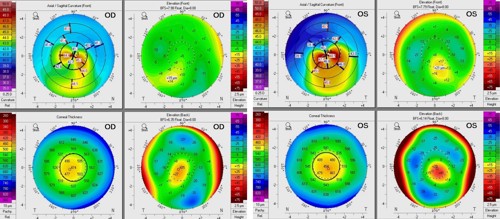
A slit lamp examination of the patient’s naked eye revealed a clear LASIK flap in both eyes, no punctate staining of the cornea, mild meibomian gland dysfunction with mild anterior squamous blepharitis of both eyelids. No signs of conjunctival hyperemia or papillae were noted. Posterior segment findings were unremarkable. Corneal tomography data confirmed post-LASIK ectasia with images of right and left eye (Figure 1).
Habitual scleral lenses were applied and she had a bilateral 2+ papillary reaction of the inferior palpebral conjunctivae in both eyes after less than 30 minutes of wear.
The patient was subsequently refit into Onefit MED (CooperVision) scleral lenses manufactured in Optimum Infinite material (Contamac). The lenses were chosen due to their ergonomic design (0.25 mm) and high-Dk value (180). Following a single redesign, the patient reported a dramatic improvement in comfort and lens tolerance. Comfortable wearing time increased from less than an hour to 8 hours while obtaining 20/20 OD and 20/25 OS visual acuity. The patient was able to discontinue all dry eye treatments and is using OTC allergy drops once per day and is currently wearing the lenses daily.
Discussion
Not all scleral lens failures are fitting failures. Emerging evidence suggests that different contact lens materials can and do influence the inflammatory environment of the ocular surface (Yüksel et al, 2015).
Conclusion
The substantial improvement to patient symptoms suggests that hyper-oxygen-permeable material selection can play a meaningful role in scleral lens success (Dhallu et al, 2020). For patients who have chronic ocular surface inflammation, ocular rosacea, allergy-prone eyes, or unexplained scleral lens intolerance, changing lens material represents a valuable troubleshooting strategy.
REFERENCES
1 Yüksel Elgin C, İskeleli G, Talaz S, Akyol S. Comparative analysis of tear film levels of inflammatory mediators in contact lens users. Curr Eye Res. 2016;41(4):441-447. doi:10.3109/02713683.2015.1037001
2 Dhallu SK, Huarte ST, Bilkhu PS, Boychev N, Wolffsohn JS. Effect of scleral lens oxygen permeability on corneal physiology. Optom Vis Sci. 2020;97(9):669-675. doi:10.1097/OPX.0000000000001557
To watch Dr. Pickens discuss this case, click here.