


The design of orthokeratology (ortho-k) lenses offers benefits to ocular surface health by retaining a thin tear reservoir beneath the lens overnight. This tear layer may be helpful in reducing dry eye symptoms in these patients.
Case Description
A 10-year-old patient presented for a comprehensive ortho-k assessment. Ocular history was significant for progressive myopia over the preceding 3 years, with documented acceleration in refractive error progression. Medical history was notable for acne vulgaris, for which the patient was using over-the-counter topical preparations, which resulted in dry eye symptoms.
Entrance unaided acuities were reduced to 20/400- OD and 20/400- OS. Current spectacle prescription (3 months old) was –4.75 –2.00 x 003 20/40- OD and –4.75 –1.25 x 180 20/30 OS, while best-corrected visual acuity (BCVA) was achieved with –5.75 –1.75 x 005 20/25 OD and –4.75 –1.75 x 007 20/25 OS. The horizontal visible iris diameter corneal (HVID) was 11.75 mm in both eyes.
Discussion
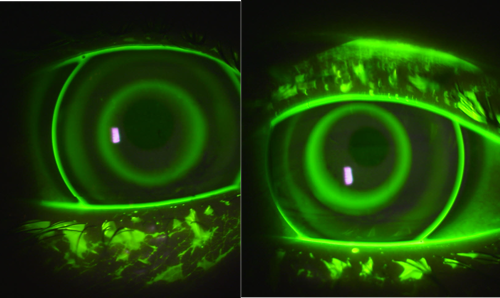
Ortho-k lenses have some unique design and fitting characteristics compared to other GP contact lenses. For instance, when the alignment curve produces an adequate peripheral seal, this reservoir can reduce tear film evaporation and help maintain ocular surface hydration. Careful adjustment of edge lift can further optimize tear exchange and minimize lens-related irritation. However, preexisting dry eye significantly disrupts the fluid dynamics and osmotic balance between the tear film and corneal epithelium, potentially initiating a cycle of cellular stress and structural compromise (van Setten, 2024; Barbosa Ribiero et al, 2024).
A reverse-geometry ortho-k lens design was selected to address the patient’s corneal topography, eccentricity, HVID, and refractive error. Material selection was critical for the treatment success. High-Dk rigid GP materials are strongly recommended for overnight ortho-k wear, as they not only provide superior corneal oxygenation but also enhance overall clinical outcomes (Lum and Swarbrick, 2022). To mitigate this risk and optimize corneal health, Optimum Infinite (Contamac), a high-Dk material with a Dk value of 180, was chosen.
The lens parameters were right eye 9.25 mm base curve (BC), +0.75 D power, and 11.20 mm diameter. Left eye was 8.92 mm BC, +0.75 power, and 11.20 mm diameter.
The lenses were DreamLens (TruForm Optics). An ortho-k lens with a total diameter of 11.20 mm was selected, given the patient’s corneal HVID of 11.75 mm. This slightly smaller lens diameter relative to the HVID was selected to optimize lens centration, minimize lens movement, and enhance overall wearing comfort.
During follow-up, the patient presented symptom free and reportedly wears her contact lenses 8 to 9 hours a night. Acuities are 20/20 OD, 20/20 OS, and 20/15 OU.
The use of high-Dk contact lens materials is essential for overnight orthokeratology to maintain corneal health during closed-eye wear. It is particularly critical to minimize corneal swelling and metabolic stress resulting from inadequate oxygen transmissibility.
Conclusion
Reduced-oxygen delivery can disrupt normal corneal metabolism and osmotic balance, potentially exacerbating epithelial compromise (Stapleton et al, 1998). Given that corneal reshaping procedures involve overnight lens wear, prioritizing corneal health, patient comfort, and long-term safety must be central to treatment planning. Use of the highest-Dk materials available should be considered the standard of care in modern ortho-k practice.
REFERENCES:
1 van Setten G-B. Cellular stress in dry eye disease—key hub of the vicious circle. Biology (Basel). 2024;13(9):669. doi:10.3390/biology13090669
2 Barbosa Ribeiro B, Marques JH, Baptista PM, et al. Corneal epithelial thickness correlation with dry eye symptom severity: a cross-sectional study. Clin Ophthalmol. 2024;18:3313-3320. doi:10.2147/OPTH.S480704
3 Lum E, Swarbrick HA. Lens Dk/t influences the clinical response in overnight orthokeratology. Optom Vis Sci. 2011;88(4):469-475. doi:10.1097/OPX.0b013e31820bb0db
To watch Dr. Schwartz discuss this case, click here.