


Managing visual rehabilitation in patients with advanced corneal ectasia who have undergone penetrating keratoplasty (PKP) poses a significant clinical challenge. While rigid GP, hybrid, or scleral lenses are traditionally favored to correct the highly irregular astigmatism associated with post-graft corneas, patient comfort and intolerance frequently lead to lens dropout. In cases in which rigid lenses fail or are rejected by the patient, custom specialty soft contact lenses designed specifically for irregular corneas emerge as a viable alternative.
Case Description
A 48-year-old Black female presented for evaluation of habitual soft contact lenses prescribed at a prior visit. She noted overall acceptable comfort in each eye but complained of lens awareness in the left eye. She has a history of dropping out of corneal GP lens wear. She has bilateral keratoconus with a history of PKP in the left eye in 2010 and the right eye in 2011. The patient denies having any systemic conditions or allergies and is not taking any systemic or ocular medications.
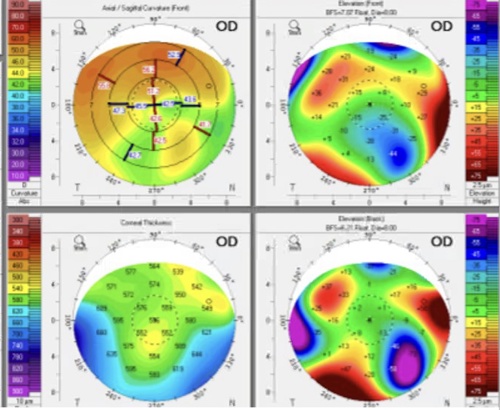
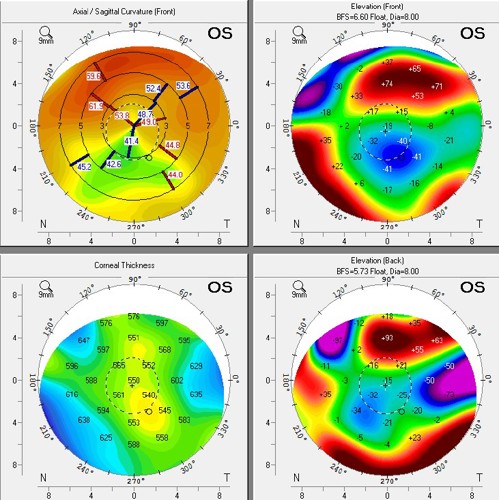
The patient’s keratometry was OD 44.00/46.50 @ 096 and OS 43.30/45.00 @ 078, while the horizontal visible iris diameter (HVID) was 11.9 mm in each eye. Manifest refraction was OD –0.50 –0.50 x 045 and OS –0.50 -–4.50 x 120 with a best-corrected visual acuity (BCVA) of OD 20/40 and OS 20/40− with a near VA of 20/30. Entrance testing was within normal limits. Slit lamp biomicroscopy showed 1+ meibomian gland dysfunction in each eye, with false lashes on the upper lid. The corneal graft was clear in each eye, with 10 sutures OD and 8 sutures OS. Corneal topography was performed in each eye (Figure 1). Her intraocular pressure (IOP) was 12 mmHg OD and 14 mmHg OS. Dilated funduscopy was unremarkable.
Evaluation of the entering lenses revealed a well-fitting soft contact lens OD in parameters 8.6/14.0/–0.75 with a VA of 20/40 and no over-refraction. A large inferior nasal bubble was noted under the habitual soft toric extended-range parameter contact lens OS with parameters 8.7/14.5/–0.50 –5.25 x 120 with VA 20/80-2.
Various alternate contact lens management options were discussed. Since the patient had previously dropped out of corneal lens wear, we recommended refitting into a custom soft lens OS for the irregular cornea.
We applied a RevitalEyes (Metro Optics) diagnostic specialty soft lens in parameters OD 8.4/14.5/PL. The over-refraction was -2.50 DS with VA of 20/30+. There was 1.0 mm of movement, and the lens was well-centered. Comfort was excellent and the diagnostic lens was ordered. We opted to leave the entering soft contact lens as-is OD. At dispense, the fit was similar to the diagnostic fit and lens was dispensed following application and removal training to ensure proper technique was employed to prevent lens damage.
Discussion
At the follow-up, vision was stable with no over-refraction. There was no corneal compromise after lens removal. The remaining supply was ordered, and we advised the patient to return in 1 year. The patient has been seen annually since this fit. This year—7 years following the initial fit—she is still happy in this specialty soft lens OS. The parameters have changed slightly over the years as she has had a broken suture removed in each eye with subsequent follow-ups with her corneal specialist.
Conclusion
The current specialty soft lens parameters are OS 8.4/14.5/STD/–3.75 DS. She is still comfortably wearing this lens combination 7 days a week for about 12 hours a day using a hydrogen-peroxide-based care system and preservative-free artificial tears up to 4 times a day.

To watch Dr. Sicks discuss this case, click here.