


Fitting irregular corneas secondary to penetrating keratoplasty (PK) presents unique contact lens challenges, particularly when graft tilt or elevation creates complex topographies. Conventional corneal rigid/GP, soft toric, and hybrid lenses often fail due to excessive mechanical strain or poor centration over elevated graft-host junction zones. Semiscleral lens designs offer a viable solution by vaulting the irregular corneal surface and landing gently on the limbal area.
This case report evaluates the fitting of a protruding, tilted graft using an oblate semiscleral contact lens guided by corneal tomography and anterior segment optical coherence tomography (AS-OCT).
Case Description
A 52-year-old male presented for a contact lens evaluation. His right eye featured a healthy 20-year-old post-PK with a graft that sat proud of the host cornea and exhibited marked tilt. The graft was elevated nasally with a steep drop-off zone in the nasal-inferior quadrant. Previous fitting attempts for the right eye using GP, soft toric, and hybrid lenses were unsuccessful. His left eye had moderate keratoconus successfully fitted with a custom GP lens.
Tomography of the right eye confirmed a reverse-geometry graft-host junction profile on the tangential curvature map and identified the highest corneal elevation point at the nasal graft-host junction on the elevation map.
The ROSE K2 XL Oblate lens (Menicon) was selected due to its reverse-geometry design for post-graft corneas, customizable edge lift, and flexible overall diameter (13.6 mm to 16.6 mm). Initial base curve (BC) selection followed the standard fitting guide and yielding a calculated 7.46 mm BC from a mean K of 7.16 mm However, trial fitting with a 7.4 mm BC lens at 14.6 mm resulted in significant bearing over the elevated nasal graft junction. To vault the high point, a steeper 7.2 mm BC trial lens was evaluated. After 20 minutes of settling, nasal clearance remained borderline at 50 µm. Consequently, a final BC of 7.1 mm was chosen.
The finalized lens prescription for this oblate design comprised lens parameters of 7.1 mm BC, 15.0 mm diameter, –7.75 D power, standard edge lift, Acuity 200 material. The visual acuity was 6/9+ (20/30+) with no significant over-refraction. With initial post-settling, nasal clearance was 192 µm.
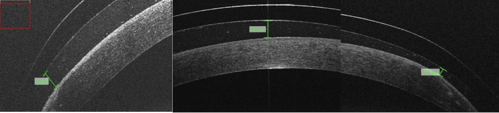
At the 2-week follow-up (6 hours of wear), clearance settled to 149 µm. At 14 weeks, composite AS-OCT demonstrated 332 µm temporal clearance, 332 µm central clearance, and maintained nasal clearance of 148 µm (Figure 1).
Discussion
This case highlights the importance of vaulting the highest elevation point of the cornea rather than relying strictly on central corneal curvature. Because the graft was elevated nasally, selecting a BC based purely on mean corneal power caused apical clearance issues. Stepping down the BC to 7.1 mm effectively elevated the lens vault, ensuring adequate clearance over the nasal junction while preventing mechanical trauma.
AS-OCT played a crucial role in monitoring tear layer thickness over time, capturing an approximate 40 µm of settling effect during initial wear. Slight peripheral asymmetry provided beneficial tear exchange without requiring a custom toric edge lift. The patient successfully reached 14 hours of daily wear time with excellent comfort, stable visual performance, and no corneal staining.
Conclusion
This oblate semiscleral lens design offered an effective fitting strategy for a complex oblate and tilted corneal grafts. Integrating tomography with AS-OCT allows precise assessment of clearance across irregular elevated zones, ensuring optimal corneal health, stability, and patient comfort.

To watch Dr. Watters discuss this case, click here.