


Scleral lenses show many benefits for improving ocular surface health and symptoms for patients suffering with dry eye conditions. Many of these patients also face visual challenges from presbyopia. This case describes a scleral lens fit for a patient struggling with a dry ocular surface and presbyopic vision demands. The design features customizable center near or center distance optics that can have variable zone size and repositioning if the lenses decenter significantly on the eye. These are often helpful features, as scleral lenses have the tendency to decenter inferior-temporally. Customization of zone size is a helpful feature depending on the patients’ visual demands, lighting conditions, and their pupil size.
Case Description
A 79-year-old female presented for scleral lens fitting with complaints of blurry vision and ocular surface dryness. She had a history of posterior chamber intraocular lenses and YAG laser capsulotomies along with epithelial basement membrane dystrophy (EBMD) in both eyes. She reported that she had not gotten relief from dryness symptoms with artificial tears, punctal plugs, or cyclosporin treatment. Her manifest refraction was +1.00 –--1.50 x 040 OD for 20/40 and –0.50 –1.25 x 070 OS for 20/80.
Topography revealed 1.00 D of irregular astigmatism OD and 1.50 D of irregular astigmatism OS due to the EBMD. Corneas showed 2+ punctate staining in both eyes. The difference in best-corrected visual acuity (BCVA) also pointed to ocular dominance OD. Her pupil size was 6 mm in mesopic lighting.
Discussion
Horizontal visible iris diameter (HVID) from topography confirmed a small corneal diameter (11 mm), so a
4,100 µm sag, 15.5 mm Delta scleral lens (ABB Optical Group) with an 8.1 mm base curve was fit in both eyes. The diagnostic lens power was –1.00 and she measured an over-refraction of +0.50 sphere and –2.00 D of against-the-rule cylinder in each eye due to her toric intraocular lenses (IOL). The toric diagnostic lenses demonstrated good stability, so the initial lenses were ordered with front toric multifocal optics, where no rotation was seen.
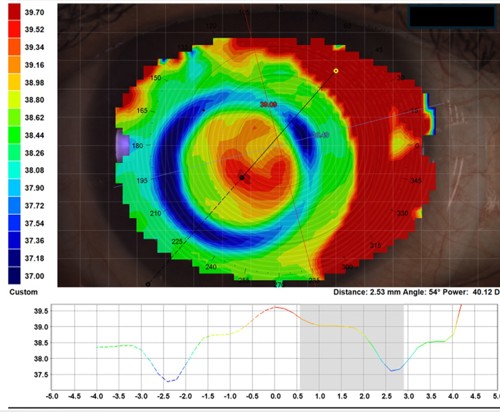
During the fitting process, lenses were designed with center-distance and center-near optics. Each type of lens was trialed, and the patient was asked to grade the visual quality subjectively from 0 (the worst) to 100 (the best) at near and distance. The subjective data indicated the patient preferred the center-near lenses for both distance and near performance. In this case, the patient reached satisfactory subjective visual performance despite some lens decentration measured with topography (Figure 1).
She only measured a +0.50 D over-refraction OD and –0.50 D OS to improve distance VA to 20/20 after settling
3 hours, which still showed 300 µm central clearance OU. The central clearance was reduced by 150 µm in both eyes, and the over-refraction was added. The polyethylene glycol surface treatment was also added to improve front surface wetting.
Conclusion
The lenses were dispensed at the next follow-up and the patient trialed them for 2 more weeks. She returned a final time to report great vision and resolution of dryness symptoms. Her corneas also showed improvement with only trace punctate staining. The patient was pleasantly surprised how much the scleral lenses helped her condition despite not having worn contact lenses in more than 30 years.
To watch Dr. Gidosh discuss this case, click here.