


Sceral lenses are commonly used for visual rehabilitation in eyes that have corneal scarring from disease, trauma, or surgical complications. Beyond their optical benefits, scleral lenses can be utilized for sustained ocular drug delivery by prolonging contact time between topical medications and the ocular surface. This case describes successful visual rehabilitation with a scleral lens in an eye that has corneal scarring following a post-cross-linking ulcer. Topical losartan was administered within the scleral lens reservoir to reduce scar density.
Case Description
A 25-year-old female who had keratoconus was referred for scleral lens fitting after developing a bacterial corneal ulcer following epithelium-off corneal cross-linking OS, resulting in corneal scarring and neovascularization. Her medical history included Loeys-Dietz syndrome and asthma. Her ocular medications included topical losartan 0.8 mg/ml 4 times per day in the left eye, which she had started 3 months prior. This was prescribed by the patient’s corneal specialist to reduce corneal scarring density.
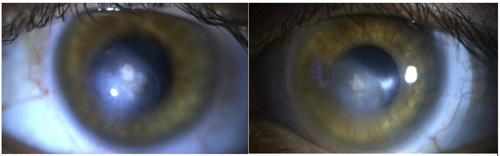
At the initial fitting visit, entering visual acuity was hand motion OS without correction. Pertinent slit lamp findings included a 5 mm round central corneal scar with dense lipid and inferior corneal neovascularization extending to the scar OS. A BostonSight Scleral lens was fit, and best-corrected visual acuity (BCVA) with the scleral lens trial was 20/40 OS. Three SmartChannels were incorporated in the lens to enhance tear exchange and reduce suction, an important consideration given the presence of extensive neovascularization.
The patient was instructed to continue use of topical losartan 4 times per day OS, instilling once before lens application, 1 drop in the bowl of the scleral lens along with preservative-free saline solution before application of lens, once midday over the lens, and once after lens removal. After 1 month of scleral lens wear and 4 months of topical losartan use, the patient’s BCVA OS was 20/25-2. After 3 months of scleral lens wear and 6 months of topical losartan use, the patient’s BCVA OS improved to 20/20.
Discussion
In this case, a scleral lens improved visual acuity while also functioning as a method to sustain corneal exposure to topical losartan during lens wear. Losartan is an angiotensin-II receptor blocker that inhibits transforming growth factor signaling, resulting in reduction of myoblast generation and thus fibrotic scar formation (Dutra and Wilson, 2025). Animal studies have shown efficacy of topical losartan in the reduction of corneal opacity after corneal injury (Sampaio et al, 2022).
Case reports describe efficacy of topical losartan in reducing haze and improving visual acuity after corneal cross-linking, PRK, and LASIK in human eyes (Rodgers et al, 2024; Wilson et al, 2025). There are currently no published guidelines for the duration of topical losartan therapy. Treatment may be discontinued once optimal visual acuity and subjective visual quality are achieved. Topical losartan is an off-label use for reducing corneal scarring; it is not FDA approved for this purpose.
Conclusion
This case highlights the potential of minimizing suction and promotion of tear exchange in scleral lenses in the vision potential and ocular surface impact in eyes that have corneal scarring. It also suggests a possible role for topical losartan in reducing scar density. More investigation is needed to better define the efficacy of topical losartan in corneal scar management.
REFERENCES
1 Dutra BAL, Wilson SE. Topical losartan in the management of corneal scarring fibrosis: update on dosage, efficacy, and potential epithelial toxicity. J Ocul Pharmacol Ther. 2025;41(5):232-236. doi:10.1089/jop.2024.0200
2 Rodgers EG, Al-Mohtaseb Z, Chen AJ. Topical losartan for treating corneal haze after ultraviolet-A/riboflavin collagen cross-linking. Cornea. 2024;43(9):1165-1170. doi:10.1097/ICO.0000000000003527
3 Sampaio LP, Hilgert GSL, Shiju TM, Santhiago MR, Wilson SE. Losartan inhibition of myofibroblast generation and late haze (scarring fibrosis) after PRK in rabbits. J Refract Surg. 2022;38(12):820-829. doi:10.3928/1081597X-20221026-03
3 Wilson SE, Dutra BAL, Wahabi K. Topical losartan in the treatment of stromal scarring after refractive surgery. J Refract Surg. 2025;41(6):e602-e610. doi:10.3928/1081597X-20250506-05

To watch Dr. Fortman discuss this case, click here.