

The Genesis of GSLS (2002–2006)
The Global Specialty Lens Symposium (GSLS) is more than just an annual conference; its history is a record of sorts - of the rapid evolution of modern specialty contact lenses. What began as a "crazy idea" written on the back of a napkin shared between the authors in 2000 has become one of the preeminent global gatherings for specialty contact lens education.
The idea was to develop and launch a standalone international conference focusing solely on specialty contact lenses. After considering event options and names, in 2001, we ultimately settled upon launching a conference dedicated to modern orthokeratology (ortho-k), naming it the Global Orthokeratology Symposium (GOS).
Despite having no funding or marketing expertise, we envisioned inviting eyecare practitioners (ECPs) from across the globe. Fortuitously, Boucher Communications Inc. (BCI), the owner of Contact Lens Spectrum at that time, was considering beginning a healthcare conference group and we combined forces with them to launch the first GOS in August 2002.
The concept for GOS was a leap of faith in many ways with numerous potential challenges to our plan. We questioned whether there was enough global interest in the topic to attract an attendee audience, and if there would be interest for potential industry support for the conference. We felt confident that there would be attendee interest from Asian ECPs who, in many ways, were more experienced with managing myopia with contact lenses—but we discovered that many of them would have difficulty traveling into the United States due to travel restrictions.
Additionally, there was a lack of US Food and Drug Administration (FDA) approvals for ortho-k lenses at this time. Only 1, the Paragon Vision Sciences Inc. Corneal Refractive Therapy (CRT), while in the approval pipeline, was still 1 to 2 years away from FDA clearance. Additionally, few clinical studies had been performed on overnight orthokeratology at this point.
Ultimately, this led us to choose a Canadian site—Toronto, Ontario—for the conference, which turned out to be a fortuitous decision. The Canadian dollar was at a low against the US dollar, making it economical for the attendees and sponsors. Also, with attendee interest high globally, this venue provided easier travel for Asian visitors to Canada than the United States.
Our philosophy was to make exhibitors feel welcome at courses and workshops, as we attempted to build the ortho-k community.
Highlighted Presentations in 2002
Looking back at the scores of presentations at the inaugural conference, there were a couple that stood out. One was “Factors affecting the forces acting on reverse geometry lenses” by John Mountford, DipAppSc. Another was “Refractive and corneal topographic changes during one month of overnight reverse geometry lens wear” by Brien A. Holden, OD, PhD, DSc. Additionally, Helen Swarbrick, PhD, explained the mechanism behind modern ortho-k presenting landmark research showing that ortho-k works via central epithelial thinning/compression and midperipheral stromal thickening.
Another highlight was the live fitting of 3 patients who slept in lenses overnight and were evaluated the following day in front of 400 attendees.
Building off the momentum of 2002, the second conference was scheduled for the summer of 2003, again being held in Toronto. Unfortunately, there was an outbreak of severe acute respiratory syndrome (SARS) that turned out to be the first pandemic of the 21st century, resulting in the cancellation of the 2003 GOS.
GOS returned to Toronto in 2004. By this time, there was FDA clearance for both Paragon CRT and a new entrant, the Bausch + Lomb Vision Shaping Treatment (VST)—both with no age restrictions—opening the door for pediatric myopia control.
Highlighted Presentations in 2004
Pauline Cho presented “The longitudinal orthokeratology research in children (LORIC) in Hong Kong: a pilot study on refractive changes and myopic control.”
Mountford presented again, this time on the biomechanics and squeeze film forces involved in modern reverse geometry lens designs, in which he described the unequal profile of the tear layer creating a positive (push force) in the center of the cornea and a negative (suction/pull force) in the midperiphery.
GOS moved to Chicago in the summer of 2005. At that event, Earl Smith, OD, PhD, presented “Peripheral vision can influence eye growth and refractive development in infant monkeys,” which introduced the theory of peripheral defocus and provided clinicians with a scientific framework to explain how myopia control works to parents and patients.
Captain James Saviola, OD, from the FDA’s division of ophthalmic devices, discussed ortho-k from the FDA’s perspective while also reviewing the current studies on overnight ortho-k.
Other highlights included lectures by Pauline Cho, BOptom, PhD, who introduced “Myopia Control with Orthokeratology”; PhD candidate Jennifer Choo, OD, who described the “Optimum Optics for Orthokeratology”; and Professor Swarbrick who addressed one of the concerns at that time with the topic of “Microbial Keratitis in Orthokeratology: The worldwide perspective.”
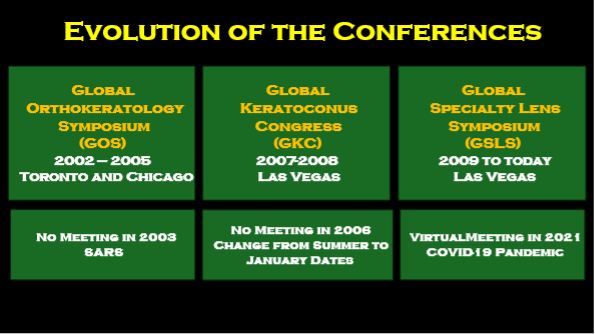
In the first years of GOS, there were a few presentations regarding other specialty lens topics such as irregular astigmatism and scleral lens designs. Based on feedback from sponsors and attendees, the decision was made to modify the meeting’s name and format along with choosing a specific time of year and location for the event. Thus, the Global Keratoconus Congress (GKC) was formed with Las Vegas as the destination and January as the target month. To ensure that there was enough time for planning, the initial event date was set for 2007, with no 2006 meeting scheduled.
This was a vibrant time for specialty contact lenses. This era marked a move away from the traditional "3-point touch" corneal GP lens fitting philosophies (which often caused scarring) toward “apical clearance” designs, largely influenced by our Australian and European colleagues.
Additionally, some of the first papers on the modern scleral lenses were presented with the topic being a revelation to the vast majority of conference participants whose only exposure to sclerals was in the history books.
Eberhard Spoerl, MD, presented “Corneal cross-linking” in 2007. This was a coup for the conference in that Dr. Spoerl’s participation in GKC was the only venue other than the American Academy of Optometry at which he presented. Dr. Spoel introduced the US audience to corneal cross-linking (CXL), providing guidelines on when to refer patients to prevent progression of keratoconus.
At this point the current conference name seemed limited, leading to another rebranding as the Global Specialty Lens Symposium (GSLS), which reflected a broader scope.
While modern scleral lens use began in Perth, Australia in 1982 with Don Ezekiel, they remained a niche modality for decades. Between 1990 and 2010, the advent of high-Dk materials and the lack of restrictive FDA clinical requirements allowed laboratories to innovate rapidly. The 2010GSLS is considered the “global launch” of the modern scleral lens. The surge in peer-reviewed publications skyrocketed after 2010, documenting the safety of a modality that was initially met with skepticism by those who believed lenses must move on the eye to be safe.
Modern Innovations and the 50th Anniversary of Soft Contact Lenses
Post-2010, the 2 major categories of change in the specialty contact lens field were the introduction of scleral lens refinements and myopia management.
As scleral lenses continued to evolve, toric haptics (c. 2015) became essential for improving the fit and stability of scleral lenses on asymmetric scleras. Scores of manufacturers globally were fabricating different designs with successful results continuing to increase. Scleral lens topics dominated the GSLS annual agenda. Lectures on the ongoing refinements of scleral lens design, fitting techniques, and post-fitting management were abundant.
Special interest groups such as the Scleral Lens Education Society (SLS) and the Scleral Lenses in Current Ophthalmic Practice Evaluation (SCOPE) group had formative meetings at GSLS resulting in international collaboration on this topic, and these groups remain vibrant today.
Beyond ortho-k, GSLS began providing training on multifocal soft lenses, atropine, and specialty spectacle lenses for myopia management. This continues to grow as more products complete R&D and clinical trials and gain FDA clearance.
A hallmark of GSLS has been that the symposium has become “home” for cornea and contact lens residents and scientific posters. Over the years, approximately 750 residents have attended the conference with more than 2,000 scientific posters presented.
A real highlight in GSLS’s history was in 2021 when a virtual-only format was employed. That year, the conference featured a tribute to the 50th anniversary of soft contact lenses. Otto Wichterle has been given credit for this invention. Initially, he and co-worker Drahoslav Lim developed hydroxyethyl methacrylate (PHEMA) in 1952 as a protentional lens material but had no way to get the lenses fabricated in his home country of Czechoslovakia.
On Christmas 1961, using his son's Erector set (Merkur), his bicycle dynamo, and a bell transformer, he built a “spincast” unit on his kitchen table where Wichterle and his wife produced the first 4 successful soft lenses.
The virtual audience in 2021 was fortunate to see a recorded interview with Wichterle’s son, Karil, about the history of the first soft lens from the experience of someone actually “in the room” at the time.
Summary
The GSLS originated from a 2000 concept to create a standalone international conference for specialty contact lenses. Initially launched in 2002 as the GOS in Toronto, the meeting navigated early challenges like the 2003 SARS pandemic and limited FDA clearances.
As clinical interest has expanded, the event has undergone several key transformations:
-
GKC (2007–2008): Rebranded as the Global Keratoconus Congress, the meeting moved to Las Vegas and introduced groundbreaking topics like CXL.
-
GSLS (2009–Present): Adopted its current name to reflect a broader scope, including the "global launch" of modern scleral lenses in 2010.
-
Myopia Management: The symposium evolved to provide essential training on multifocal soft lenses, atropine, and specialty spectacles.
GSLS remains a hub for knowledge exchange around the globe with international contributors from Australia, Europe, Asia, North America, and South America routinely involved in the conference agenda.
The conference continues to be held on an annual basis, mostly as a live event, although post-COVID there have been both virtual and hybrid meetings.